
HPV Vaccine in India 2026: The Free Government Campaign, Cervavac vs Gardasil, and What Parents Should Do
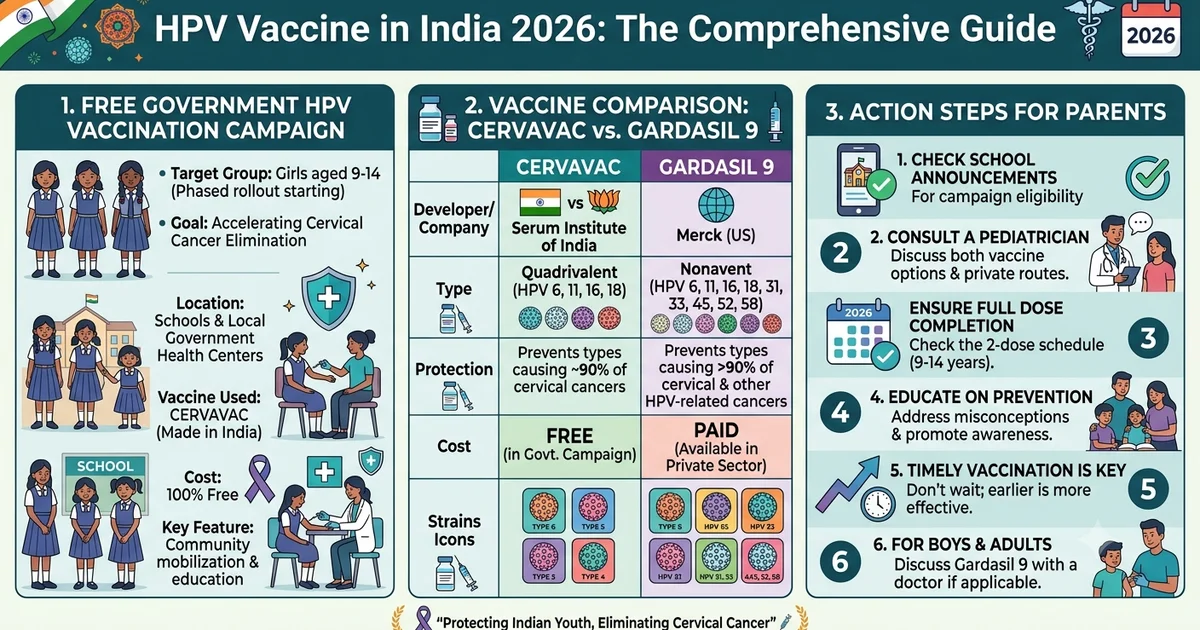
India launched free HPV vaccination for 14-year-old girls in 2026. Here's how the campaign works, how Cervavac compares to Gardasil, the right age for boys and girls, and where to get it privately in Delhi NCR.
In February 2026, India launched its first nationwide free HPV vaccination campaign — a landmark step against cervical cancer, which kills roughly 42,000 Indian women every year. If you're a parent trying to make sense of the news, the brands, and the "right age," this guide breaks it all down.
Why HPV vaccination matters
Human papillomavirus (HPV) causes nearly all cervical cancers, along with several other cancers affecting both women and men. The vaccine works best when given before any exposure to the virus — which is why it's recommended in early adolescence, years before it could ever be needed.
The 2026 free government campaign
- Who: Girls aged 14, at government facilities
- How many doses: A single dose, backed by WHO evidence that one dose gives robust protection in this age group
- Which vaccine: The campaign uses Gardasil-4 (quadrivalent) via a partnership with GAVI, the Vaccine Alliance
- Scale: Around 11.5 million 14-year-old girls targeted nationwide
This is free at government facilities. Families who want to vaccinate at a different age, choose a different brand, or include boys can do so privately.
Cervavac vs Gardasil: what's the difference?
Cervavac is India's first indigenous HPV vaccine, made by the Serum Institute of India. It's quadrivalent (protects against HPV types 6, 11, 16 and 18) and is significantly more affordable — roughly ₹2,000–4,000 per dose privately.
Gardasil 9 is a nine-valent vaccine that protects against additional high-risk HPV types. It costs more but offers the broadest coverage. Gardasil 4 (quadrivalent) is also available.
All are excellent choices. For most families the decision comes down to budget and breadth of coverage — your paediatrician can help you weigh it.
What age, and how many doses?
- 9–14 years: Two doses (0 and 6–12 months). This is the ideal window.
- 15 years and older: Three doses.
- Government campaign: Single dose for 14-year-old girls.
What about boys?
Yes — IAP recommends HPV vaccination for boys too. HPV causes cancers of the throat, anus and penis in men, and vaccinating boys also reduces transmission. The free government campaign currently targets girls, but boys can be vaccinated privately.
Is it safe?
HPV vaccines have an excellent safety record across hundreds of millions of doses worldwide. The most common side effects are mild and short-lived: soreness at the injection site, occasionally a mild fever. Serious reactions are very rare.
Getting the HPV vaccine at home in Delhi NCR
If your child is due for HPV vaccination and you'd rather skip the clinic, The Vaccine Panda brings it to your doorstep across Delhi, Noida and Gurgaon — cold chain maintained, GST invoice included. Book a home visit or see the full vaccine catalogue.
Sources: GAVI; Serum Institute of India (Cervavac); Press Information Bureau, Government of India — Cervical Cancer Vaccination Campaign (Feb 2026).
Tags: